Forged From Old Shell Casings: A Kinmen Artillery Knife vs. a $120 Western Chef's Knife
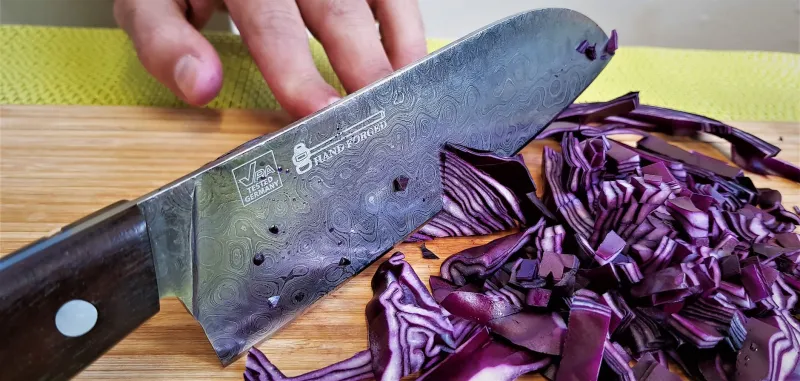
Every few months, someone on a cooking forum posts a photo of a knife with a faintly mottled, no-nonsense blade and a brass-ferrule handle, captioned with some version of: this was made from a bomb that landed on a Taiwanese island in 1958. Then the thread splits in two. Half the replies call it the best $60 kitchen tool on earth. The other half call it a souvenir that will chip the first time it meets a butternut squash.
I spent a month cooking with one to figure out which camp is right.
The Shell Story, Stripped of the Brochure
Kinmen — Quemoy on older American maps — sits a couple of miles off the Fujian coast and a couple of hundred miles from Taipei. During the 1958 bombardment, an estimated tens of thousands of artillery shells fell on the island over roughly six weeks. Decades later, local smiths in the island's knife shops started buying up demilitarized shell casings and turning them into cutlery. The trade is real, it's still running, and the shops will happily show you a crate of casings before they show you a knife.
Here's the part the marketing skips: a shell casing is not a magic metal. It's a decent high-carbon steel that happens to be free, already cylindrical, and thick enough to forge down. The romance is genuine. The metallurgy is just steel.
How the Forging Actually Works
A casing gets cut into blanks, heated to forging temperature, hammered or press-shaped into a profile, then quenched and tempered. From there it's grinding, bevel-setting, handle fitting, and sharpening — most of it by hand, which is exactly where quality starts to scatter from knife to knife.
The resulting blade is thin behind the edge, hard, and takes a genuinely wicked sharp edge off a 1000-grit stone. Typical examples land somewhere in the high-50s on the Rockwell C scale, though shops rarely publish verified numbers and I'd treat any quoted figure as marketing until you test it.
The Contender on the Other Side of the Board
For comparison I used a $120 Western-style chef's knife — the kind of 8-inch German-steel workhorse that a lot of American kitchens end up with. Softer steel, thicker grind, a full bolster, a handle built for rocking chops, and a factory edge that's serviceable rather than thrilling.
That knife is not the enemy here. It's the benchmark most US buyers already own, and the honest question is whether a forged-in-Kinmen blade does anything the benchmark can't.
Cutting Room Notes
Onions and tomatoes: The Kinmen blade wins, and it isn't close. That thin, hard edge glides through tomato skin without a sawing motion and slices onion without mashing the layers. The Western knife does the job with more pressure and more tears.
Carrots and sweet potatoes: Still the Kinmen knife, though you can feel the edge flex-loading on dense material. Go slow.
Butternut squash: The Western knife, comfortably. Splitting a squash with a hard, thin, high-carbon blade is how people end up with a chipped tip and a bad mood. The thicker German grind shrugs it off.
Chicken bones and frozen anything: Western knife only. Do not twist a hard, thin blade through a joint. It will not forgive you.
Long sessions: The Western knife's heavier handle and fuller grind are less fatiguing if you're prepping for a crowd. The Kinmen blade rewards precision, not volume.
Where the Kinmen Knife Loses
Three places, honestly.
First, consistency. Two knives from the same shop can arrive with noticeably different bevel angles, handle gaps, or spine thickness. You are buying a hand-finished object, and hand-finished means variance.
Second, reactivity. This is carbon steel. Cut a lime, walk away for ten minutes, come back to a stain. Some people love the patina. Some people post angry reviews.
Third, the total price. A mid-size Kinmen slicer or cleaver often runs $45–$90, and shipping from Taiwan to the US typically adds $25–$45. Landed, you're frequently within $20 of that $120 Western knife — before you've bought a stone.
Upkeep: Treat It Like Cast Iron's Sharp Cousin
Wipe and dry immediately after every use. A drop of camellia oil or food-safe mineral oil on the blade between sessions is not optional in a humid American summer. Never the dishwasher — heat, detergent, and jostling are three separate ways to ruin it. Sharpen on a whetstone; skip the pull-through gadget, which will chew up a thin hard edge faster than any vegetable will.
Do that, and the edge lasts. Skip it, and you'll be the person in the forum thread calling it a gimmick.
The US Buyer's Practical Checklist
Legality: Fixed-blade kitchen knives are legal to import into the US and legal to own in every state I could verify. What gets flagged is anything described as a dagger, a switchblade, or a concealed-carry weapon — so keep the listing clearly labeled as kitchen cutlery, and never let a seller mark it as a "tactical knife." If you're hand-carrying one home, it has to go in checked luggage.
Shipping: Use a forwarder or shop that explicitly ships cutlery to the US and provides tracking. Expect air freight of one to three weeks. Ask whether the seller declares the item accurately — vague customs labels on a sharp object are how packages get held.
Spotting quality before you pay:
- Ask for a photo of the actual knife you'll receive, not the catalog shot.
- Look for an even grind line from heel to tip. Wobble means a rushed job.
- Check the handle-to-bolster junction for light gaps.
- Ask the spine thickness and the blade weight in grams.
- Confirm whether the bevel is 50/50 or asymmetric, and whether they'll match your handedness.
- Prefer shops that include an origin certificate or a photo of the shell stock. Not because the paper makes it cut better, but because shops that bother are usually the ones with tighter QC.
- Skip the Damascus-patterned "presentation" versions unless you're buying wall art. Etched patterns on these blades are cosmetic.
So: Bargain or Souvenir?
It's a real knife with a real story, and those two things don't cancel each other out. Buy one because you want a thin, hard, absurdly sharp slicer and you're willing to dry it every single time — and because having a kitchen tool with a literal history in it is worth something. Buy the $120 Western knife instead if you want one blade to handle squash, bones, and a rushed Tuesday without being babied.
Most people who cook seriously end up with both. The shell knife is the one guests ask about. The Western knife is the one that gets used when nobody's watching.