I Spent $12 on a Yunlin Hand Towel and Logged It Against a $40 Bath Towel for Ten Washes
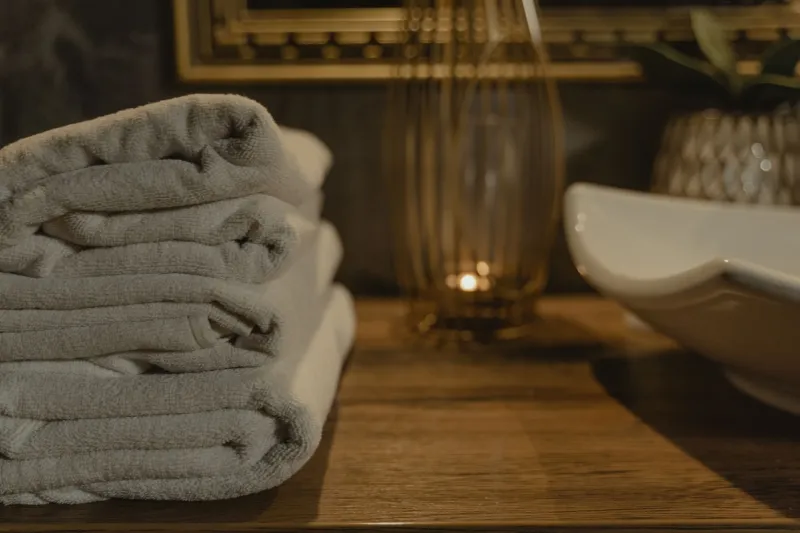
This started as a small purchase and turned into a spreadsheet. I ordered a hand towel from a small mill in Huwei, a township in Yunlin County that has been weaving cotton since the 1950s, for $12 including my share of the shipping. Sitting next to it in my bathroom was a $40 bath towel from a US brand I'd bought on sale and felt smug about.
Different jobs, obviously. One dries your hands; one wraps your whole body. But if you measure quality per gram of cotton and per dollar spent, the comparison stops being silly pretty quickly.
The contenders
| Taiwan hand towel | US bath towel | |
|---|---|---|
| Size | 33 x 76 cm | 70 x 140 cm |
| Weight | 105 g | 620 g |
| Material | 100% cotton, ring-spun | 100% cotton, zero-twist |
| Construction | Low loop pile, densely packed | High loop pile, plush |
| Price paid | $12 shipped | $40 (sale) |
| Certification | MIT textile mark, number on the care label | Not applicable |
The weight ratio is roughly 6:1. The price ratio is 3.3:1. That gap is the whole story, and everything below is me trying to figure out whether it's justified.
Test 1: absorbency
I ran two versions of the same test, three times each, on freshly washed, unsoftened towels.
The drop test: a single drop of water from a medicine dropper, timed until it fully disappeared into the pile. The Taiwan towel wicked it in about 2 seconds flat. The bath towel took 4 to 5 seconds, which is what high, fluffy loop pile does — it holds water in the gaps before the fiber itself starts pulling.
The soak test: weigh the towel dry, submerge for 60 seconds, let it drip for 30, weigh again. The Taiwan hand towel held about 3.2 times its own dry weight. The bath towel managed about 2.6 times. Density beats fluff when you're measuring cotton against cotton.
This is not a knock on the bath towel. It's warm, it drapes, and it does a job the hand towel physically cannot. But the plush stuff you're paying extra for is partly air.
Test 2: drying time
Hanging both on separate bars in the same bathroom, 68°F, exhaust fan running, no windows.
- Taiwan hand towel: dry to the touch in 1 hour 50 minutes
- US bath towel: dry in 5 hours 20 minutes
Some of that is just physics — less mass, less water to evaporate. But the low, tight pile also exposes more surface area per ounce, so the margin is wider than the weight difference alone predicts. In a small apartment bathroom with no window, that's the difference between a towel that smells fine on day three and one that doesn't.
Test 3: ten washes
Hot water, regular detergent, low tumble, no fabric softener for the first five cycles, then softener on the last five to see how both handled it.
Taiwan hand towel: some light surface pill on the first wash, then basically nothing. Hems stayed flat. Edges didn't curl. Absorbency dropped about 3% over ten cycles. After softener entered the picture, absorbency dropped another few points, which is what softener does to every cotton towel on earth.
US bath towel: more visible pilling along the fold lines, no hem issues. Absorbency dropped roughly 12% across the ten cycles, and it got noticeably fluffier in a way that reads as nicer but performs worse.
Neither towel fell apart. The smaller one just didn't degrade.
Cost per use, done honestly
A hand towel in a bathroom gets replaced every two or three days and washed constantly. Call it 150 wash cycles over two years of real service: $12 ÷ 150 ≈ 8 cents per use.
The bath towel, rotated with a second one, realistically gets 200 cycles over three years: $40 ÷ 200 = 20 cents per use.
That comparison is a little unfair because you need a bath towel. But when I ran the version that actually matters — four hand towels at $12 each versus one more $40 bath towel — the $48 pile of small towels covered the whole bathroom, dried fast, and outlasted its counterpart on absorbency retention.
Why a small mill in Huwei can pull this off
Huwei's towel cluster grew up in the 1950s and got flattened when cheaper imports opened up. The mills that survived did it by going small-batch and branded instead of chasing volume: short dye runs, tighter weave density, ring-spun cotton that pills less because the fibers are aligned before spinning.
You can feel the difference in the hand. Dense and slightly grippy, not plush. It doesn't photograph as luxuriously, which is exactly why it doesn't get marked up the way "hotel-quality Turkish cotton" does.
Buying one without paying the taste tax
Things I'd check before ordering:
- Gram weight per towel, in the listing. If the seller won't state it, the towel is probably thin. A decent 33 x 76 cm hand towel lands around 100 to 120 g.
- Fiber content on a photographed care label. "Cotton-rich" is not 100% cotton.
- The MIT textile mark with a registration number next to the fiber and care information, usually sewn into the seam.
- A named origin — Huwei, Yunlin, Changhua — with a mill name attached. Township names are a soft signal; the mill name is a hard one.
- Ship with other things. A single $12 towel across the Pacific is a bad deal on freight. Bundle three or four, or add pantry items to the same box and the per-item shipping collapses.
What I'd skip: anything sold as "Taiwanese-style cotton" with no weight, no fiber photo, and a stock image of a spa.
The verdict
My $40 bath towel is fine and I'm keeping it. But the $12 hand towel won on absorbency per gram, drying time, durability through ten washes, and cost per use — and it did it without a single luxury adjective in its packaging.
Buy the small towels. Buy four. Put the savings toward the bath towel you actually want, and stop paying plush-markup prices for cotton that's mostly air.