The Overnight Test: A $22 Taiwan Vacuum Flask Against the $45 Bottle Strapped to Every Backpack
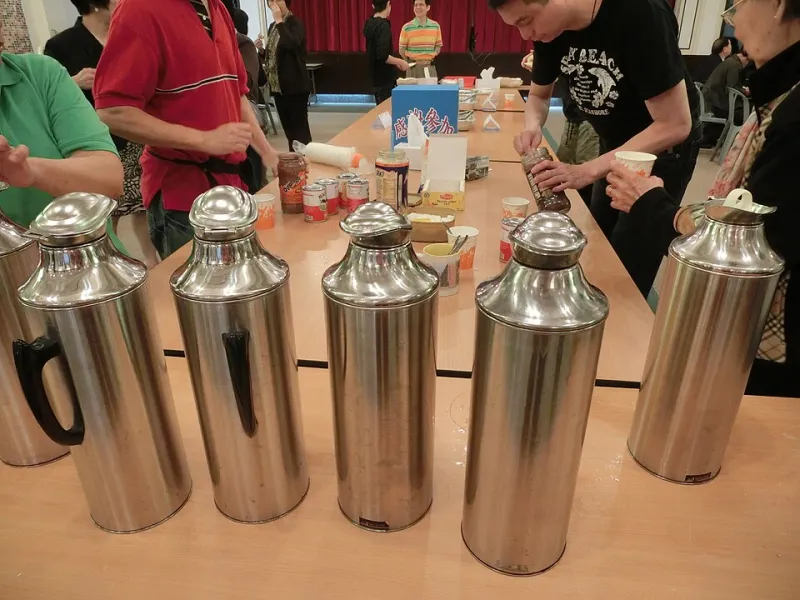
Photo: Ewloskalw, CC BY-SA 3.0, via Wikimedia Commons
There are two kinds of people in a cold-weather parking lot: the ones who brought coffee, and the ones asking the first group where they got it. I've been both. So when a Taiwan-made stainless flask showed up for $22 shipped — roughly half what the well-known outdoor bottle costs at any big-box store — I decided to settle it the only way that means anything: fill both at dawn, abuse them all day, and see what's left at bedtime.
The rules were simple. Same preheated water, same starting temperature, same ambient conditions. One flask goes in a canvas tote, the other in a backpack side pocket, which is where bottles actually live and also where they get dropped.
The 5:40 a.m. Fill
Outside temperature when I set the kettle going: 38°F. Inside: warm kitchen, still sleepy. I preheated both vessels with hot tap water for two minutes, dumped it, then filled each with 200°F water straight from the kettle and capped them tight.
First difference showed up before I left the house. The Taiwan flask has a wider mouth — wide enough to drop in a tea bag without a funnel, wide enough that steam curls out and warms your face on the way to the car. The bigger-name bottle has a narrower opening that's better for sipping while walking and worse for basically everything else.
The second difference came at the car: the $45 bottle's lid is a two-piece affair with a silicone gasket that seats with a satisfying click. The $22 flask is a single screw cap with a gasket you can see if you look. No click. No drama. Just threads.
Twelve Hours, Checked Four Times
I checked with an instant-read thermometer at four points, taking the reading in the cup rather than the vessel so I wasn't poking around in the drink itself.
- 7:30 a.m. (parking lot, 36°F): Taiwan flask 187°F. Name-brand bottle 189°F. Practically a tie, and both still too hot to drink without a wince.
- 11:00 a.m. (soccer sideline, 41°F, wind): 168°F vs. 171°F. Both plenty hot. The three-degree gap is real but you would never taste it.
- 3:00 p.m. (kitchen counter, indoors): 149°F vs. 155°F. Here the gap widened, which is what you'd expect from a thinner-walled vessel. Still hot coffee, just a shorter window before it becomes "warm coffee."
- 5:40 p.m. (twelve hours in): 134°F vs. 143°F. Both drinkable. Neither one is going to make you a fresh cup at bedtime.
That's a nine-degree spread after half a day — meaningful on paper, close to invisible in your mouth. What the numbers don't capture is where the cheap flask lost ground: the shoulder of the bottle. The metal above the vacuum cavity got genuinely warm to the touch by afternoon, which tells you the insulation isn't doing much in that band. The expensive bottle stayed cold everywhere except the cap.
The Sideline Pour, Which Is the Real Test
Temperature is a spreadsheet. Pouring is a marriage.
The narrow-mouth bottle dribbled twice when I poured into a travel mug at the sideline — not leaked, just that annoying trickle down the outside that makes you wipe your hand on your jeans. The wide-mouth Taiwan flask poured clean, every time, because I could see what I was doing.
The catch: the wide mouth also means more exposed surface when it's open. Every pour vents heat. So the flask wins on control and loses a little on retention, and it's the same design decision causing both. If you drink straight from the vessel, buy narrow. If you pour for other people — kids, thermoses, a friend who forgot theirs — buy wide.
Lid drips: neither one dripped in the bag, but the Taiwan flask's cap collects a ring of condensation in its inner threads that you'll notice when you unscrew it in a warm room. A quick shake handles it. The name brand's gasket design avoids that but is also the part that eventually grows a smell if you don't pull it out and wash it.
Dishwasher Wear, Twice Through
Both claim dishwasher safe. I ran both on the top rack twice over two weeks.
The Taiwan flask came out with faint water spotting on the brushed finish, which wiped off. Paint — the powder coat — held up fine, including after a genuinely unkind drop onto asphalt at the sideline, which scuffed but didn't chip.
The expensive bottle's silicone gasket started to look tired after the second cycle. Not failed, just soft. That gasket is a $6 replacement part and the reason some people hand-wash a $45 bottle they bought specifically so they wouldn't have to think about it.
Does the Import Price Still Make Sense?
Here's the honest math. The flask was $22 with shipping folded in, ordered from a Taiwan listing that shipped in nine days. The name-brand bottle was $45 at retail. That's a $23 gap, which is roughly two bags of decent coffee.
What you're paying the extra $23 for: a lid that seals more confidently, insulation that holds through the shoulder, and a replacement-parts ecosystem you can find at any outfitter in the country. What you're giving up by going cheap: about nine degrees after twelve hours, a slightly wetter cap, and the small gamble that a listing with three photos is describing what it's actually shipping.
For a commuting mug or a thermos that lives in a car cupholder and gets refilled at lunch, the $22 flask is not a compromise. It's the better buy. For a bottle that goes on a twelve-mile hike and must still be hot at the summit, pay the $45 and stop thinking about it.
Spotting Real Vacuum Insulation in a Taiwan Listing
A few things I now check before hitting buy on any stainless flask:
- "Double-wall vacuum" is a claim; "18/8 stainless, vacuum-sealed, tested 12-hour retention" is a specification. Look for numbers, not adjectives.
- Weight is a tell. A true vacuum flask feels light for its size. A heavy one is often just two shells with air between them.
- Check the shoulder in photos. Real vacuum construction has a visible seam line low on the body where the air was drawn out and sealed.
- Look for MIT or a named factory. Taiwan's metal goods often carry a manufacturing mark or a factory name in the listing. It's not a guarantee, but a seller proud enough to name the plant usually isn't hiding a single-wall can inside.
- Read the lid. Screw caps with a replaceable gasket beat molded one-piece lids you can never fully clean.
- Confirm the capacity in ounces, not "large." Listings that use vague sizing are usually vague about everything.
Would I buy it again? I already did — a second one for the car, in a color that hides scuffs. The expensive bottle still goes in the hiking pack. Both of them are in the rotation, which is probably the most honest verdict a $22 upstart could hope for.