Plug Grip and Warm Plastic: Four Sub-$35 Taiwan Power Strips Under a Real Desk Load
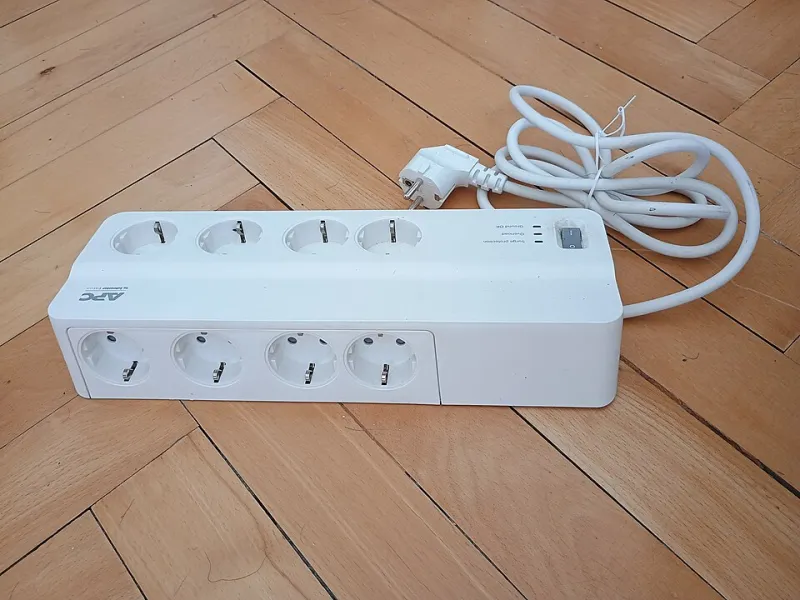
Photo: Roy Zuo, CC BY-SA 4.0, via Wikimedia Commons
A power strip is one of those purchases you make in a panic at 11 p.m. and then never think about again, which is exactly why the bad ones stay in service for a decade. I cleared my desk, unplugged everything, and spent a month rotating four Taiwan-made surge protectors through the same load: a laptop dock, two 27-inch monitors, a desk lamp, a small speaker, and a phone charger. Roughly nine amps at peak. Not a server rack, but not a phone and a lamp either.
All four cost between $12 and $33. Here's what the money actually buys.
The Four Strips
- The $12 four-outlet. No switch, no surge light, 1.25-inch outlet spacing, two-foot cord, 400-joule rating printed in six-point type on the back.
- The $18 six-outlet. A lighted rocker switch, 1.5-inch spacing, four-foot cord, 600 joules, two USB-A ports.
- The $25 eight-outlet. Switch with a real click, 1.75-inch spacing, six-foot cord, 1,200 joules, clamping voltage printed on the housing, mounting slots on the back.
- The $33 eight-outlet. Metal-ish housing, switch plus a surge-protection indicator LED, 2,000 joules, eight-foot cord, and a flat plug that fits behind furniture.
First, the Plug Question
Taiwan runs 110 volts at 60 hertz on Type A and Type B outlets — the same shapes and the same power as the US. That means a Taiwan-market strip plugs into a US wall outlet with no adapter, and US devices plug into it without one. This is not true of most of the world, but it is true here, and it's why Taiwan-made strips show up in US listings at all.
The catch is certification. A legitimate Taiwan strip carries the BSMI mark — the Bureau of Standards, Metrology and Inspection — with a model number and usually a commodity inspection code. That mark speaks to Taiwan's safety testing, not to UL listing. For a US buyer, look for one of two things: a UL or ETL mark on the strip itself, or a Taiwan strip whose internal surge module is a branded, UL-recognized component. If neither is present and the joule rating is the only safety claim on the package, treat it as a plain extension cord and don't put a space heater on it.
Grip, Switch, and Spacing
I plugged and unplugged a lamp cord 50 times into each strip and measured the pull force with a luggage scale.
The $12 unit started at about 4.5 pounds of retention and was down to 3 pounds by the end. Not loose enough to fall out on its own, but loose enough that a bumped cord could interrupt a monitor. The $18 and $25 units held between 5.5 and 6.5 pounds throughout. The $33 unit was the tightest at almost 7 pounds and stayed there.
Switch feel matters more than people admit, because the switch is the part you touch daily. The $12 strip has no switch at all — you unplug it, which means crawling under the desk. The $18 switch is mushy and its light is dim. The $25 switch has a crisp detent and a bright, unambiguous light. The $33 is similar to the $25 with a slightly heavier action.
Spacing is the quiet dealbreaker. At 1.25 inches, two chunky laptop bricks will block the outlet between them. At 1.5 inches you can usually seat two adapters side by side. At 1.75 inches, almost anything fits. If your desk has a dock brick and a monitor power supply, don't buy anything under 1.5 inches.
Heat Under Load
I ran each strip for 90 minutes with roughly nine amps of draw at a 71°F room and took surface readings with an infrared thermometer at the plug faces and the switch.
- $12 strip: 109°F at the warmest plug face
- $18 strip: 101°F
- $25 strip: 96°F
- $33 strip: 94°F
All four stayed within what I'd call safe, but the $12 strip ran warm enough that I could feel it with a palm and warm enough that I wouldn't stack it under a rug or behind a cushion. The two larger strips barely registered. Heat is mostly about conductor gauge and how tightly the internal bus is assembled, and the cheap unit is clearly using less of both.
Reading the Surge Ratings
Joules get marketed like horsepower, and the number alone is close to meaningless. What actually helps: a clamping voltage around 330 to 400 volts (lower is better), a response time under a nanosecond, and a UL 1449 listing for the surge module. Only the $25 and $33 strips listed a clamping voltage at all, and both landed at 400 volts.
One more thing most listings bury: surge protection degrades. A strip that takes a big hit is no longer protecting anything, which is why the $33 unit's indicator LED is genuinely useful and the $12 unit's absence of one is genuinely not.
Was the $12 Strip Ever Right?
The $12 strip is fine for a phone charger, a lamp, and a speaker — low draw, rarely touched, not behind furniture. It is the wrong strip for a home office where a dock and two monitors live, not because it will catch fire, but because the grip loosens, the spacing fights you, and there's no switch and no surge indicator. You'd replace it within a year, and the $18 unit costs six dollars more.
What I'd Buy Again
The $25 eight-outlet is the one staying under my desk. Six-foot cord, real spacing, a switch I don't mind using twice a day, 1,200 joules, and it stayed cool. The $33 version is better built and better for tight spaces thanks to the flat plug, but unless you need the eight-foot cord or the metal housing, you're paying for refinements rather than safety.
Buy the middle one. Put the twelve-dollar strip in the guest room, where it belongs.